
Definition
Local-first describes the default boundary, not an absolute ban on networks.
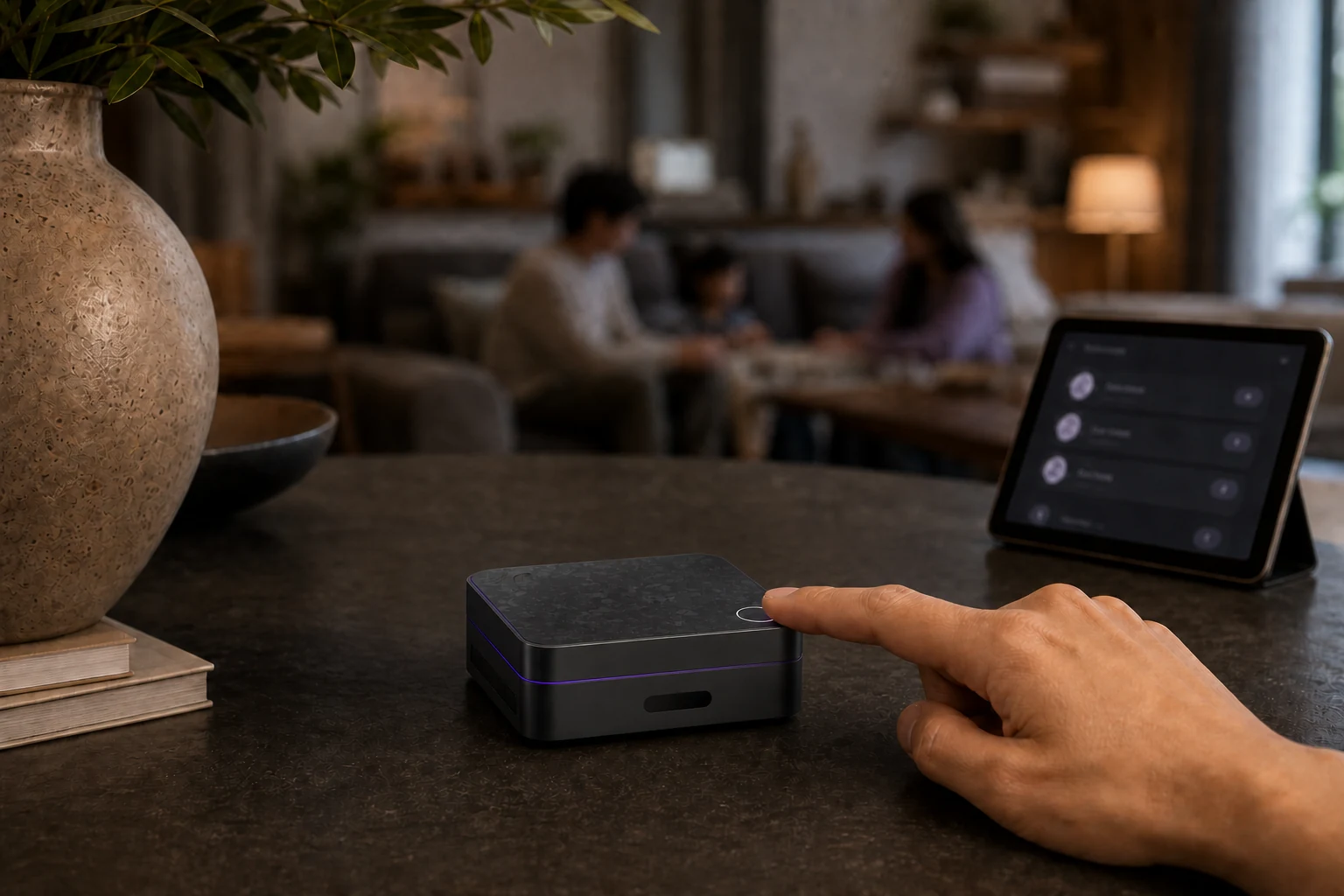
A local-first system is designed so its essential home functions and private context can live on hardware the household controls. That is different from a cloud-only service whose primary intelligence, history, or control path depends on a vendor account and remote infrastructure.
The term should not be used as a shortcut for perfect privacy. Remote access, notifications, third-party integrations, model downloads, backups, and optional cloud AI can still create external data flows. A credible product should name those flows instead of claiming that every future feature is fully local.
- State which functions work without the internet.
- Separate required cloud services from optional ones.
- Document what leaves the home and why.
- Avoid treating a component claim as a complete-system guarantee.
Architecture
Useful home AI needs context, permissions, and an action boundary.
A model alone does not make a household system useful. The system also needs a device graph, event history, identity and permission rules, and a clear way to decide whether to answer, ask, notify, or act.
HarborNavi's product direction is to connect selected home signals into local household context, then keep sensitive actions reviewable. It is not a promise to control every device, and it does not replace the need to secure the underlying network, accounts, cameras, and automation platform.
Connections
Interoperability is verified path by path.
Camera compatibility depends on protocols, profiles, codecs, credentials, event support, and network configuration. RTSP can provide a media-control path, while ONVIF profiles define sets of interoperable functions; neither label means that every feature on every camera will work.
The same discipline applies to smart-home devices. A local controller can expose entities and actions, but the reliability and privacy of the whole workflow still depend on each integration and the services it uses.
- Verify the exact camera model and ONVIF profile.
- Check whether events and audio are exposed, not only video.
- Keep credentials and device permissions scoped.
- Test failure behavior when the network or an integration is unavailable.
Trade-offs
Local-first shifts responsibility as well as control.
Keeping more work at home can reduce routine data exposure and cloud dependency, but it also makes hardware capacity, updates, backups, network quality, and recovery planning more visible to the owner or product maker.
The right choice depends on the household. A camera appliance can be simpler for video-only needs, a cloud assistant can offer broader online services, a DIY stack can provide maximum flexibility, and a professional system can transfer design and maintenance to an integrator.